
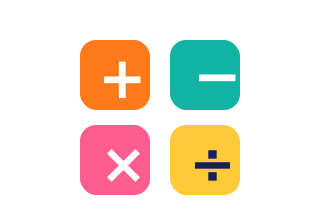
The four basic operations are the foundation of all mathematics. When children first meet them through real objects — beads, sticks, counters and coins — the rules start to make sense instead of being memorized.
+ Addition
Putting together. Use beads on an abacus or counters in two groups, then join them and count all.
− Subtraction
Taking away or finding the difference. Jump backward on a floor number line or remove counters from a group.
× Multiplication
Repeated addition. Arrange objects in rows and columns (arrays) — 3 rows of 4 make 12.
÷ Division
Equal sharing or grouping. Share 12 sweets equally among 3 friends and see how many each gets.
From concrete to abstract
- Concrete: students handle real objects — beads, sticks, blocks or play money.
- Pictorial: they draw dots, tally marks, number lines or arrays to show the same idea.
- Abstract: only then do they write the number sentence, such as 3 × 4 = 12.
Speed + Accuracy = Mastery
Once a concept is understood, short timed practice — just a few minutes a day — builds fluency. Encourage students to beat their own time while keeping every answer correct.